

The wealth of information available on the FMG website required a focus on navigation, functionality and presentation of largely written content. We focused on the typography, pairing a calligraphy font-face for headings with a sans-serif font for main copy for ease of reading. Referencing books from the medieval period, we also included stylised drop-caps as a style option.
Easy Navigation
The navigation menu affixes to the top of the screen so visitors can easily navigate between sections without the need to scroll back up to the main menu. On some pages, there is also a right-hand menu available for navigation within that section that affixes, again to allow for ease of access.
PDF Previews
The Foundation holds a number of scanned sources on its website for public access. Rather than requiring the visitor to download each scanned source, they have the option to view online-- a pop up box then opens with the document in a web browser.
Library Database
The FMG library is searchable on its website. Visitors can opt to view the full library, or those materials held at the Oxford library. Visitors going to the Oxford library are able to plan their visit in advance by consulting the online database to confirm what materials are available at the library.

Public vs. Members
The site has public content as well as content restricted to members.
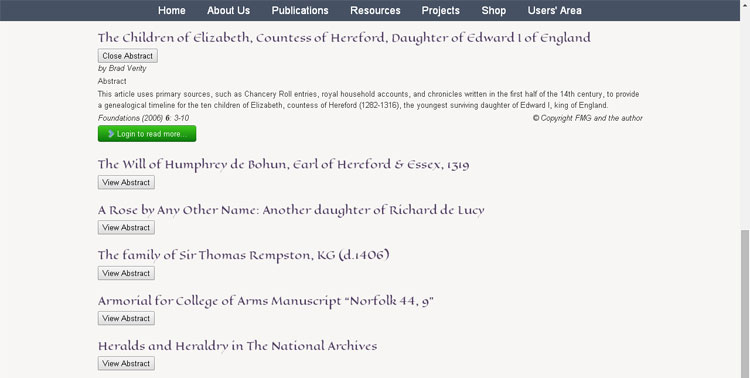
On the Journal pages, recent editions are all available to read online. Public visitors are able to view the full table of contents and abstracts, but further reading is unavailable until the visitor has logged in. This creates a continuity between the public and registered views so the Foundation doesn't have to maintain 2 different versions of the same content.
- Written by Maureen Young
- 20 June 2014